
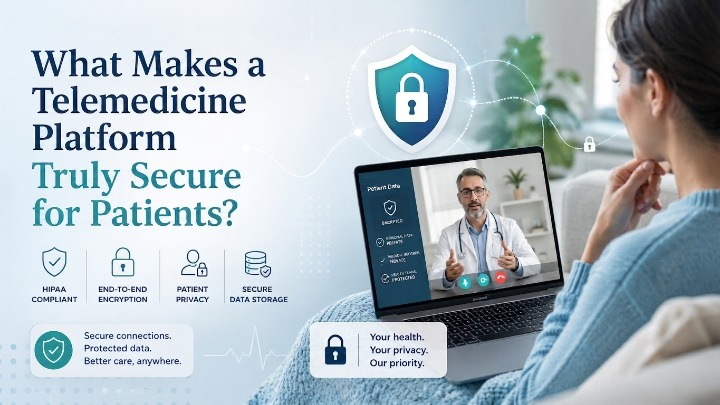
What Makes a Telemedicine Platform Truly Secure for Patients?
Telemedicine has made healthcare easier for many people. A patient can speak with a doctor from home, share symptoms through a mobile app, receive follow-up care, and manage health concerns without sitting in a waiting room. For busy families, older adults, people with limited mobility, and patients living far from clinics, this convenience can make a real difference.
But convenience alone is not enough.
When a patient uses a telemedicine platform, they are not just sharing a name and phone number. They may be sharing medical history, prescriptions, lab results, insurance details, images, payment information, and very private conversations. That is why a telemedicine platform must do more than simply connect a doctor and patient through video. It must protect the patient at every step.
A truly secure telemedicine platform is built around trust. Patients should feel safe before, during, and after their virtual visit. They should know their information is handled carefully, their session is private, and their data is not being exposed unnecessarily.
Security Starts With Patient Privacy
The first sign of a secure telemedicine platform is how seriously it treats privacy. A patient should clearly understand what information is collected, why it is needed, how it will be used, and who can access it.
Healthcare data is sensitive. A small privacy mistake can create real harm for a patient. It can lead to embarrassment, financial fraud, medical identity theft, or even discrimination. HHS explains that without proper privacy and security protections, unauthorized access to patient health information can cause serious personal, financial, and reputational harm.
A strong platform does not collect extra information “just because it can.” It follows a simple rule: collect only what is needed for care, billing, support, or legal requirements. This is often called data minimization, and it is one of the most patient-friendly security habits any healthcare platform can follow.
HIPAA Compliance Is a Foundation, Not a Marketing Line
For telemedicine platforms used by covered healthcare providers in the United States, HIPAA compliance is not optional. HIPAA protects patient health information, and telehealth appointments, messages, billing details, and related health data are covered in much the same way as in-person care. HHS states that covered providers must use telehealth platforms that support secure communication and data storage.
A secure platform should also work with vendors that are willing to sign proper Business Associate Agreements when required. This matters because many telemedicine services depend on third-party tools, such as video software, cloud storage, payment processors, analytics tools, and messaging systems. If those vendors touch protected health information, they must follow strict privacy and security responsibilities.
Still, HIPAA compliance should not be treated as a checkbox. A platform can say it is compliant, but patients and providers should look deeper. Does it use encryption? Does it control staff access? Does it log activity? Does it have a breach response plan? Does it regularly review risks? These details show whether security is actually part of the system.
Secure Login and Identity Protection
A patient portal should never be easy for the wrong person to enter. Secure login is one of the most basic parts of patient protection.
A strong telemedicine platform should support strong passwords, two-step verification, and secure account recovery. HHS also recommends multi-factor authentication when available because it makes it harder for someone else to access an account with only a stolen password.
This is especially important because many patients use the same email or password across different websites. If one account is exposed somewhere else, a weak telemedicine login could put health data at risk. Multi-factor authentication adds another layer, such as a code sent to a phone or email.
The platform should also help patients recognize trusted login links. Fake appointment links and phishing emails are common risks. If a patient is unsure about a link, HHS advises contacting the healthcare provider directly to confirm whether it is valid.
Encryption Must Protect Data in Motion and at Rest
Encryption is one of the clearest signs that a telemedicine platform takes security seriously. It helps protect information by making it unreadable to anyone who does not have proper access.
There are two important areas here. First, data should be encrypted while it moves between the patient and the provider. This includes video calls, chat messages, forms, images, and uploaded documents. Second, data should be encrypted when it is stored, such as in patient records, servers, backups, and cloud databases.
HHS recommends using encryption tools when available for devices and apps used to communicate with healthcare providers. For a telemedicine company, encryption should not be an optional extra. It should be part of the system from the beginning.
Private Video Sessions and Safe Communication
A secure telemedicine platform should protect the actual appointment experience. The video session should not be public, searchable, or easy for outsiders to join. Meeting links should be unique. Sessions should have waiting rooms or access controls where needed. Providers should be able to verify that the right patient has joined.
Privacy also depends on the patient’s surroundings. HHS recommends taking telehealth appointments in a private place, using headphones when needed, avoiding speakerphone in shared spaces, and positioning the screen so others cannot see it.
The best platforms help patients prepare for this. They may show a simple reminder before the visit: “Choose a private place,” “Use headphones,” or “Make sure your internet connection is secure.” These small touches make security feel practical instead of complicated.
Access Controls for Doctors and Staff
A secure platform does not allow every employee to see every patient record. Access should be based on role and need.
For example, a doctor may need to see medical notes, prescriptions, and test results. A billing team may need payment and insurance details. A support agent may only need basic account information. Each person should only see what is necessary for their job.
The HIPAA Security Rule requires reasonable safeguards to protect electronic protected health information, including administrative, physical, and technical protections. It also focuses on confidentiality, integrity, and availability of health information.
Good access control also includes audit logs. These logs show who opened a record, when they opened it, and what action they took. If something suspicious happens, the organization can investigate quickly.
Secure Devices and Updated Software
A platform can be well built, but patients and providers still use real devices: phones, tablets, laptops, and home Wi-Fi. Security must account for that.
HHS recommends installing security updates, using a personal device when possible, turning on lock screens, avoiding public Wi-Fi, and deleting health information from devices when it is no longer needed.
A good telemedicine platform supports these habits. It should work smoothly on updated browsers and mobile devices. It should avoid forcing patients to download risky files. It should log users out after inactivity. It should also make it easy to remove uploaded documents or old messages when appropriate.
Clear Consent and Transparent Data Use
Patients should not feel confused about what they are agreeing to. A secure telemedicine platform gives clear consent options in simple language.
Before a visit, patients should know whether the session may be recorded, whether messages are stored, how prescriptions are handled, and how their information may be shared with labs, pharmacies, insurers, or other care teams.
Transparency builds trust. If a platform uses tracking tools, analytics, or third-party services, it should explain that clearly. HHS guidance also encourages providers to tell patients about the privacy and security practices of telehealth vendors and whether the app or website uses online tracking technologies.
A Strong Breach Response Plan
No responsible platform should act as if risk does not exist. Even strong systems can face attempted attacks. What matters is preparation.
A secure telemedicine platform should have a clear plan for detecting, reporting, and responding to security incidents. It should know how to investigate unusual activity, lock affected accounts, notify the right people, and fix the issue quickly.
Patients deserve honesty. If their information is affected, they should be informed in a clear and respectful way. Security is not only about prevention. It is also about accountability.
Patient Education Should Be Built In
Many patients are not cybersecurity experts, and they should not have to be. A secure platform makes safe behavior easy.
Simple reminders can help patients avoid common mistakes. The platform can guide them to use strong passwords, check appointment links, avoid public Wi-Fi, update their devices, and choose a private space for consultations.
This education should be written in plain language. It should also be accessible for people with disabilities or limited English proficiency. HHS notes that providers may need to offer support such as interpreters, translations, or auxiliary aids so patients can understand telehealth privacy and security information.
True Security Feels Simple for the Patient
The best telemedicine security does not make patients feel stressed. It protects them quietly while keeping the experience smooth.
A secure platform should be easy to log into, easy to understand, and easy to trust. Patients should not have to search for privacy settings or guess whether a link is real. They should not wonder who can see their data. They should not feel that convenience comes at the cost of safety.
In the end, a truly secure telemedicine platform is not defined by one feature. It is defined by the full experience: private communication, strong login protection, encryption, limited data collection, responsible staff access, clear consent, vendor accountability, patient education, and a serious response plan.
Telemedicine is built on connection. Security is what makes that connection safe enough for patients to use with confidence.