
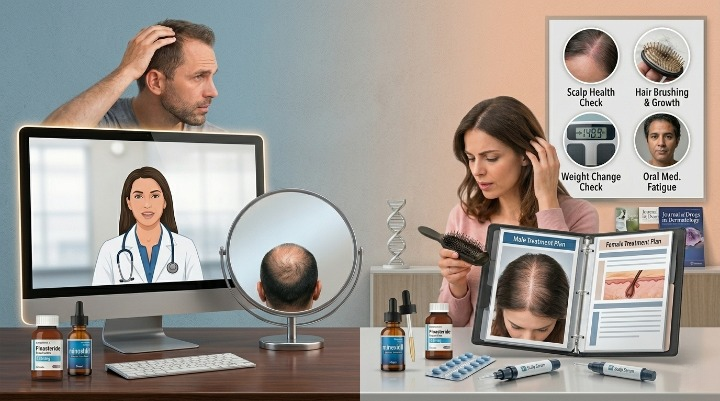
Hair Loss in Men vs Women: Best Telehealth Treatment Options
Hair loss is often talked about as if it’s the same for everyone. But in reality, it looks and feels very different depending on who is experiencing it.
For men, it may show up as a receding hairline or thinning at the crown. For women, it often appears as overall thinning, especially around the part line. Both experiences are valid, but they are not identical.
And that difference matters more than most people realize.
Because when the pattern is different, the treatment should be different too.
With the rise of telehealth, more people now have access to personalized hair loss care from home. But understanding how treatment varies between men and women is the first step toward choosing the right approach.
Understanding the Difference: Men vs Women
Hair loss in men and women is often caused by the same underlying condition androgenetic alopecia but it behaves differently.
In Men
Hair loss usually follows a clear pattern:
- Receding hairline
- Thinning at the crown
- Gradual progression into baldness
This is largely driven by a hormone called DHT (dihydrotestosterone), which shrinks hair follicles over time.
In Women
Hair loss tends to be more diffuse:
- Widening part
- Overall thinning
- Reduced hair volume
Women rarely experience complete baldness, but the emotional impact can be just as significant.
Hormonal changes especially during pregnancy, menopause, or stress often play a larger role.
Why Treatment Needs to Be Different
Even though the root cause may overlap, treatment options are not always the same.
For example:
- Some medications are approved only for men
- Hormonal balance plays a bigger role in women
- Dosage and application may differ
This is why a generic solution often fails.
A more personalized approach like the one offered through telehealth is usually more effective.
The Rise of Telehealth in Hair Loss Treatment
Telehealth has changed how people access care.
Instead of waiting for appointments, you can now:
- Complete an online consultation
- Share your symptoms and history
- Receive a treatment plan tailored to you
But the real benefit is not convenience it’s precision.
A good telehealth platform doesn’t just recommend products. It builds a plan based on your condition.
What Telehealth Doctors Look For
Before prescribing anything, doctors typically assess:
- Your hair loss pattern
- Medical and family history
- Lifestyle factors (stress, diet, sleep)
- Hormonal indicators
This helps determine whether your hair loss is:
- Hormonal
- Temporary (stress-related)
- Nutritional
- Chronic
Once the cause is clear, treatment becomes much more targeted.
Best Telehealth Treatments for Men
For men, treatment often focuses on addressing DHT and supporting regrowth.
1. Finasteride (Hormonal Treatment)
Finasteride is one of the most commonly prescribed medications for male pattern hair loss.
It works by blocking the hormone DHT, which is responsible for shrinking hair follicles. By reducing DHT levels, it helps slow down hair loss and protect existing hair.
It is FDA-approved for men and usually taken as a daily oral medication.
However, it is not typically prescribed to women due to safety concerns.
2. Minoxidil (Growth Support)
Minoxidil is widely used in both men and women.
It works by improving blood flow to the scalp and helping hair follicles stay active longer.
For men, it is often used alongside finasteride for better results.
Results usually take a few months, and consistency is essential.
3. Combination Therapy
Doctors often recommend combining both treatments.
- Finasteride slows hair loss
- Minoxidil promotes regrowth
This approach is considered more effective than using either treatment alone.
Best Telehealth Treatments for Women
Treatment for women requires a slightly different approach.
1. Minoxidil (First-Line Treatment)
Minoxidil is the primary FDA-approved treatment for women with pattern hair loss.
It is usually applied topically and works similarly as it does in men supporting hair growth and improving thickness.
It is often the starting point for most treatment plans.
2. Hormonal Therapies
In some cases, doctors may recommend treatments that help balance hormones.
These can include medications like:
- Anti-androgens
- Hormone regulating therapies
These are prescribed carefully, depending on individual health factors.
3. Nutritional and Lifestyle Support
For women, hair loss is more likely to be influenced by:
- Iron deficiency
- Stress
- Hormonal fluctuations
That’s why telehealth plans often include:
- Diet improvements
- Stress management strategies
- Supplement recommendations
How Telehealth Personalizes Treatment
One of the biggest advantages of telehealth is customization.
Instead of following a fixed plan, doctors can:
- Adjust medications
- Modify dosage
- Combine treatments based on response
This flexibility improves outcomes over time.
What About Safety?
This is where telehealth needs to be approached carefully.
While many platforms provide excellent care, not all follow strict medical standards.
Some concerns include:
- Over-prescription without proper evaluation
- Limited explanation of side effects
- Use of unapproved or compounded products
Recent reports have also raised concerns about certain topical medications being promoted without full safety evaluation.
This highlights the importance of choosing a trusted provider.
Managing Expectations: What Results Look Like
Hair loss treatment is not immediate.
Most people:
- Notice changes after 3 to 6 months
- Experience gradual improvement
- Need ongoing treatment to maintain results
For example, stopping treatments like minoxidil can reverse progress over time.
The goal is not instant regrowth it’s long term control.
The Emotional Side of Hair Loss
Hair loss affects more than just appearance.
It can impact:
- Confidence
- Self-image
- Social comfort
This is true for both men and women, even if the patterns differ.
That’s why having a clear plan and understanding what’s happening can make a significant difference.
Choosing the Right Telehealth Option
If you’re considering telehealth for hair loss, look for:
- Proper medical evaluation
- Clear explanation of treatment
- Personalized recommendations
- Ongoing support
Avoid platforms that offer:
- One-size-fits-all solutions
- Instant results promises
- Limited medical guidance
Final Thoughts
Hair loss in men and women may share similarities, but the experience and the treatment can be very different.
Understanding those differences is key to finding the right solution.
Telehealth has made personalized care more accessible than ever. But the effectiveness of that care depends on how well it is tailored to you.
Because in the end, successful treatment is not about using more products.
It’s about using the right treatment, for the right reason, at the right time.